

The Complete Guide to Gym Equipment Storage Solutions
Addressing the Operational Chaos of Poor Equipment Organization
In high-traffic commercial fitness environments, disorganized equipment is more than a visual nuisance; it is a direct threat to operational efficiency and user safety. Facility managers frequently encounter the 'trip hazard' scenario where stray kettlebells, loose dumbbells, or misplaced resistance bands obstruct walkways. This chaos is rarely the result of a lack of space, but rather a failure in structural logic and specialized storage-system integration.
When equipment is left on the floor or incorrectly stacked, the underlying cause is often an inadequate mismatch between the equipment's weight profile and the storage unit's load capacity. This results in premature wear of the flooring, damaged equipment coatings, and increased liability. To resolve this, operators must transition from 'temporary placement' mentalities to a permanent, engineered storage infrastructure that dictates exactly where every piece of gear belongs.
The Hidden Costs of Improper Storage
Ignoring organized storage leads to accelerated depreciation. For example, stacking olympic plates haphazardly can lead to bent shafts or damaged edges on rubber bumper plates. Furthermore, the time lost by staff or members searching for specific weights can decrease the overall perceived value of a premium facility. By implementing a standardized storage protocol, you mitigate these risks and extend the lifecycle of your capital investments.
Optimizing Free Weight Management and Dumbbell Racks
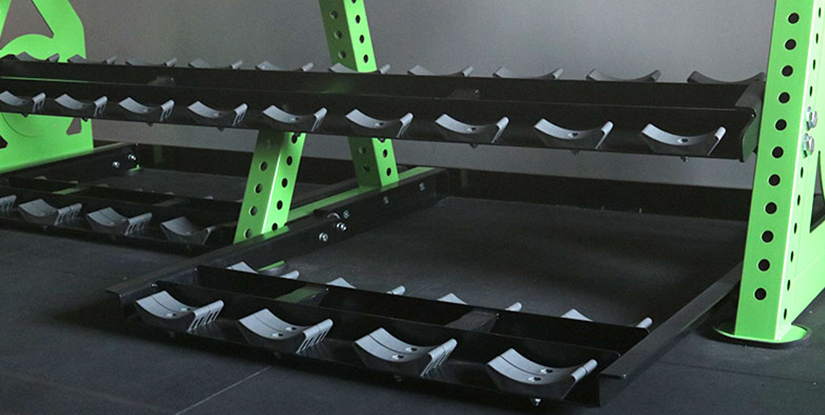
Free weights represent the highest density of weight in any facility, making them the most critical component of a storage strategy. The primary failure mode in weight management is 'weight creep,' where dumbbells of various increments are mixed, causing confusion and slow-paced workouts. The solution lies in high-grade, tiered dumbbell racks designed for specific weight ranges.
When selecting dumbbell storage, operators must consider the 'access-to-weight' ratio. A rack that is too deep requires users to move multiple weights to reach one in the back, which increases the risk of drops. A well-designed system uses angled or tiered configurations to ensure visibility and ease of retrieval.
| Storage Type | Best For | Primary Benefit | Risk Factor |
|---|---|---|---|
| Two-Tiered Dumbbell Rack | Standard Dumbbell Sets | Space efficiency in narrow lanes | Overloading top tier stability |
| Vertical Plate Trees | Olympic and Bumper Plates | Quick access for heavy lifting | Center-of-gravity issues |
| A-Frame Plate Racks | Bumper Plates | Visual clarity and ergonomics | Tip-over risk if base is narrow |
| Horizontal Barbell Racks | Olympic Barbells | Protecting knurling and shafts | Floor space consumption |
Weight Distribution and Structural Integrity
A common mistake is selecting racks based on aesthetic appeal rather than weight-bearing specifications. A commercial-grade dumbbell rack must be rated for the total weight of a full set plus a 15% safety margin. Operators should verify the load-bearing capacity of the steel frame and the thickness of the uprights before installation to prevent structural bowing over time.
Advanced Solutions for Small-Format and Functional Training Tools
While free weights demand heavy-duty steel, functional training tools—such as medicine balls, kettlebells, and resistance bands—require a different approach. These items are often lightweight but highly mobile, leading to them being 'lost' in the facility. The cause is often a lack of designated, specialized housing.
Kettlebell storage, for instance, requires heavy-duty, wide-base racks. Because kettlebells have a high center of gravity when lifted, their storage must reflect that stability. For lighter accessories like resistance bands or yoga mats, vertical wall-mounted solutions or modular cubby systems are far more effective than standard bins, which tend to become disorganized quickly.
Vertical Space Utilization Strategies
In facilities where square footage is at a premium, verticality is the most effective tool. Wall-mounted racks for medicine balls or specialized pegboards for resistance bands allow the floor area to remain clear for movement-based training. This transition from horizontal to vertical storage can reclaim up to 20% of usable floor space in a standard functional training zone.
Explore the complete technical specifications:
Implementing Specialized Storage for Long-Form Equipment
Barbells, landmines, and long-form training implements present a unique challenge because of their length. Improper storage of these items often leads to damage to the bar's knurling or bending of the shaft due to uneven pressure. The mechanism of failure here is usually 'unsupported cantilever,' where the weight of the bar hangs off an edge without a proper cradle.
<To fix this, operators should deploy vertical barbell holders or specialized floor-mounted racks that cradle the center of the bar. This prevents the weight from concentrating on the ends. For landmines and combat sports equipment, dedicated wall-mounted hooks or floor-standing uprights are essential to prevent them from leaning against walls or other machines, which can damage both the equipment and the facility's paintwork.
Verification Checklist for Barbell Storage
- Check for Cradle Depth: Does the rack hold the bar securely, or can it slide out easily?
- Inspect Surface Finish: Are the contact points coated in rubber or high-density plastic to prevent metal-on-metal contact?
- Measure Footprint: Does the rack provide enough stability to prevent tipping when a heavy bar is removed?
Explore the complete technical specifications:
Material Selection for Long-Term Durability and Maintenance
The material of the storage solution is as important as its design. In a high-humidity or high-use gym environment, cheap powder coatings will chip, leading to rust. This is especially problematic for metal-on-metal storage solutions. A professional buyer should prioritize high-grade, electrostatically applied powder coatings and heavy-gauge steel construction.
The interaction between the equipment and the storage material determines the maintenance interval. For example, metal-on-metal contact in a barbell rack will eventually result in scratches and surface oxidation. To prevent this, choose racks with high-density polyethylene (HDPE) or vulcanized rubber inserts. These materials act as a buffer, absorbing vibration and protecting the finish of the equipment.
| Material Component | Recommended Standard | Reason for Selection |
|---|---|---|
| Rack Frame | 11-gauge or 12-gauge Steel | Prevents deformation under heavy load |
| Contact Points | Vulcanized Rubber/HDPE | Protects equipment finish and dampens noise |
| Coating | Electrostatic Powder Coat | Resistance to scratches and oxidation |
| Base/Feet | Non-slip Rubberized Bases | Prevents floor sliding and protects flooring |
Preventing Layout Failures through Strategic Zonation
A major mistake in gym design is the 'randomized placement' of storage units. When storage is placed without regard to the training zone it serves, it creates bottlenecks. For example, placing a heavy plate rack in the middle of a high-traffic cardio path is a recipe for accidents. The cause is a lack of a master floor plan that integrates storage into the zone layout.
The fix is to implement 'Zonal Storage.' Each training area (Strength, HIIT, Cardio, Stretching) should have its own dedicated, specialized storage system. This prevents users from wandering across the facility to return an item, which keeps the designated zones efficient and safe. During the planning phase, operators must verify the 'traffic flow' by simulating the movement of members with equipment in hand.
The Impact of Ergonomic Design on User Behavior
If a storage solution is difficult to use, users will not use it. If a kettlebell bin is too high or a barbell rack is too narrow, members will likely leave equipment on the floor. This is a psychological response to poor ergonomics. By investing in accessible, ergonomic storage, you subconsciously encourage better facility maintenance habits among your members.
Safety Inspection and Routine Maintenance Protocols
Even the best storage solutions require regular inspection to remain effective. The primary failure mode in aging storage systems is 'structural loosening,' where bolts and fasteners vibrate loose due to constant loading and unloading. This can lead to a catastrophic failure if a heavy rack becomes unstable.
Operators should implement a monthly inspection checklist to verify the integrity of all storage units. This is not just about the equipment, but the stability of the support structures themselves. A rigorous maintenance schedule ensures that the storage solution remains a benefit rather than a liability.
Standard Monthly Inspection Checklist
- Fastener Audit: Check all bolts, nuts, and screws on weight racks for tightness.
- Structural Alignment: Inspect uprights and frames for any signs of bowing or leaning.
- Coating Integrity: Look for chips or rust in the powder coating that could affect equipment.
- Stability Test: Physically check that the unit does not wobble or tilt when loaded.
- Weight Verification: Ensure all weight increments are correctly labeled and present.
Explore the complete technical specifications:
Future Trends in Modular and Smart Gym Storage
As facility design evolves, we are seeing a shift toward modularity. Modern gym storage solutions are becoming more adaptable to changing floor plans. Instead of fixed, heavy-duty installations, many operators are moving toward modular, stackable, and movable systems that can be reconfigured as the facility's needs change. This allows for a higher return on investment as the business grows or pivots its training focus.
Furthermore, the integration of 'smart' features—such as RFID-enabled tracking for high-value equipment—is a growing trend. While more advanced, these systems can help operators manage inventory and ensure that expensive items are not only stored correctly but are also accounted for at all times. This level of oversight marks the transition from simple organization to sophisticated asset management.