

Interlocking vs. Roll Mats: Which One for Commercial Gyms
Interlocking vs. Roll Mats: Which One for Commercial Gyms
When choosing flooring for a commercial gym, should you go with interlocking mats or roll mats? Both materials look like they protect the floor, but the use scenarios, installation methods, and long-term costs are completely different. Choose wrong, and you are not just spending more money. You are dealing with seam cracking, edge curling, and difficult cleaning every single day. This article helps you make the right decision from four angles: structure, installation, maintenance, and durability.
Related reading: Ten Details That Tell a Reliable Rubber Factory
Interlocking Mats: Flexible but with Seams
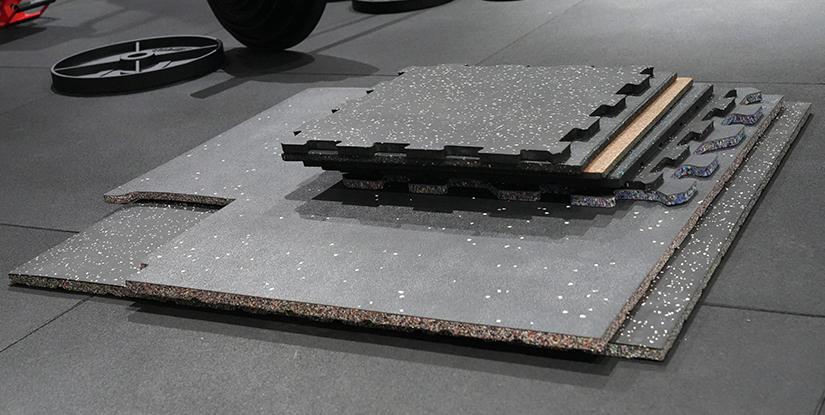
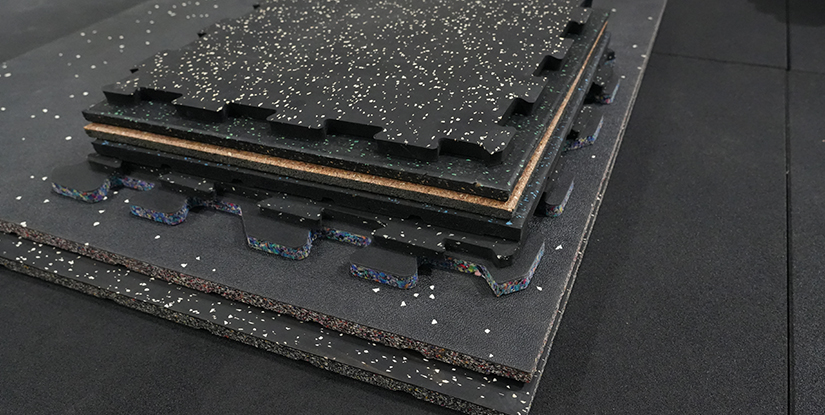
Interlocking mats have interlocking teeth on the edges and are installed like puzzle pieces. No glue is required. No professional tools are needed. Two people can finish a studio floor in half a day.
The advantages are clear. Ease of installation is the biggest selling point. Uneven floors can be leveled locally. Damaged tiles can be replaced individually. The entire floor can be taken apart and moved when relocating. For small studios, group exercise rooms, and temporary spaces, these features are very practical. Another advantage is DIY-friendliness. Owners can install the mats themselves, saving on labor costs. Mistakes can be undone, and corners can be cut with a utility knife.
But the disadvantages of interlocking mats are equally significant. First, seams. Every tile has a seam. The seams cannot be completely eliminated. Dust, sweat, and rubber debris get trapped in them. Cleaning requires pressure washers or vacuums. A mop does not clean them thoroughly. Second, edge curling. Heavy equipment rolling over the seams gradually causes the edges to curl up. Stepping on curled edges creates a tripping hazard. Third, deformation under load. When bumper plates are dropped on a seam, the interlocking teeth can deform or break. Localized load-bearing capacity is weaker than continuous roll matting.
The service life of interlocking mats in commercial environments is usually shorter than roll mats. The main reason is wear and curling at the seams. This does not mean interlocking mats cannot be used. It means you need to understand their limitations. They are suitable for light to medium loads and spaces that need flexibility. Heavy strength training areas are not recommended for interlocking mats.
Roll Mats: Seamless but Permanent
Roll mats come in wide rolls, typically 1.2 to 1.8 meters wide. Once installed, the entire floor is one continuous piece with no seams.
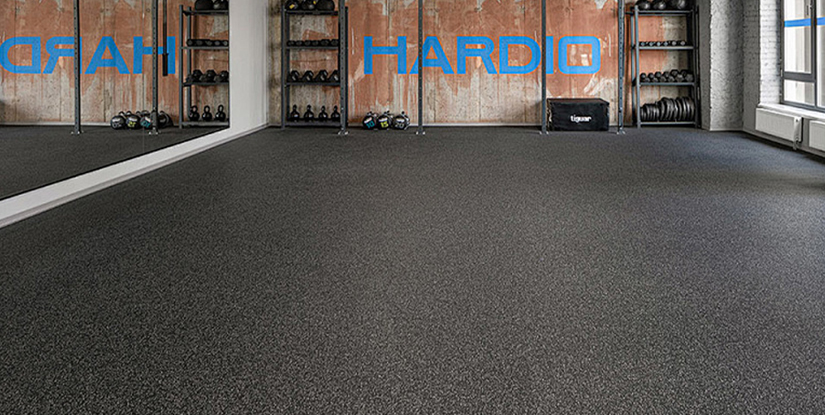
The advantage is continuity. No seams mean no places for dirt to hide. Cleaning is efficient. Heavy equipment will not cause localized curling because the entire mat is continuous and forces are distributed. Roll mats usually outlast interlocking mats under the same material quality. Strength training areas, cardio zones, and free weight areas in commercial gyms are more commonly fitted with roll mats.
The disadvantages are equally significant. Installation requires professional tools and skilled workers. The floor must be flat, or the roll will bubble. Adhesive is the common installation method. Once glued down, it is difficult to remove. Damage cannot be repaired by replacing a small section. A large area must be cut out and replaced. Transport and handling are also much more difficult than interlocking mats. Rolls are heavy, take up space, and require forklifts or cranes.
Another hidden cost of roll mats is floor preparation before installation. The floor needs grinding, crack repair, and moisture treatment. Skipping these steps will cause problems soon after installation. Many buyers only calculate the material cost of the matting and ignore floor preparation. In reality, floor preparation can account for 20 to 30 percent of the total budget. This is a cost that interlocking mats do not incur.
Related reading: Why Mass Production Differs from the Sample
Installation Difficulty and Labor Costs
Interlocking mats do not require additional labor costs. Owners can install them themselves. Two people covering 100 square meters do not need professional knowledge. The only tools needed are a rubber mallet and a utility knife, which cost almost nothing. If disassembly and reinstallation are needed, interlocking mats can be taken apart and reused multiple times without material loss.
Roll mat installation requires a professional crew. Floor grinding, crack repair, primer application, mat placement, roller pressing, and seam heat welding all require experience and tools. An inexperienced crew will produce bubbling, seam cracking, and uneven edges. Installation costs typically range from 20 to 40 percent of material costs, depending on floor conditions and installation difficulty.
More importantly, installation quality directly affects service life. The gap between a professional crew and an amateur crew is huge. Professional crews produce roll mat floors that last 8 to 10 years. Amateur crews may produce floors that fail within 3 years. The problem is usually in the seam welding. Insufficient heat causes weak welding. Excessive heat burns the material. Weakly welded seams crack open within months of use. This difference is invisible at delivery but shows up soon after installation.
If budget is limited but you want the roll mat effect, there is a compromise: lay the roll mat without adhesive and secure the edges with perimeter strips. This method does not require glue and can be done by yourself, but edges tend to curl and service life is shorter than glued installation. Suitable for temporary spaces or tight budgets.
Long-Term Maintenance and Replacement Costs
Over the long term, roll mats have lower maintenance costs. Cleaning takes less time, and replacement frequency is lower. Quality roll mats in commercial environments last 8 to 10 years. Interlocking mats typically last 5 to 7 years before seams show significant wear.
Replacement of interlocking mats is local. Replace the damaged tiles without removing large areas. But the problem is color difference. After two years of use, new tiles will be a visibly different color from old tiles. If you do not mind the color difference, local replacement is very cost-effective. If you do mind, you have to replace the entire area, which is no longer a small job.
Roll mat damage requires full-section replacement. Cut out the damaged area, lay new roll mat, and weld the seam. Replacement costs are high, and color difference between old and new rolls is also a problem. Different batches of roll mats can have color variation, so you may need to use stock from the same batch for repairs.
Daily cleaning is also part of long-term costs. Interlocking mats need regular vacuuming or pressure washing of the seams. A mop is not enough. Roll mats can be cleaned with a mop. In a large facility, the cleaning efficiency gap is significant. A 500-square-meter gym saving one hour of cleaning time per week saves 50 hours of labor per year.
Interlocking vs. Roll Mats: Core Comparison
| Factor | Interlocking Mats | Roll Mats |
|---|---|---|
| Installation method | Puzzle-fit, no glue required | Glue-down or loose-lay, professional installation |
| Labor cost | DIY, no extra cost | Professional crew required, 20%-40% of material cost |
| Floor requirement | Minor unevenness acceptable | Must be flat, or bubbling occurs |
| Seams | Seams exist, trap dirt | Seamless, good integrity |
| Cleaning and maintenance | Seams require pressure washing | Mop enough, simple |
| Durability | Seams curl and wear, 5-7 years | Continuous structure, 8-10 years |
| Partial replacement | Single tile replaceable, color difference | Full section replacement, high cost |
| Best use case | Small studios, group rooms, temporary spaces | Large commercial gyms, strength areas |
| Total cost of ownership | Lower upfront, moderate maintenance | Higher upfront, lower long-term maintenance |
When to Choose Interlocking Mats
Interlocking mats are suitable for three types of spaces. First, small studios and group exercise rooms. The area is not large, and you need to adjust the layout flexibly. You can install them yourself. Second, spaces that need frequent disassembly or relocation. Leases are not fixed, spaces are temporary, and you need to take the mats with you when you move. Third, floors with uneven surfaces. Interlocking mats have a support structure underneath and can be locally leveled without large-scale floor preparation.
Interlocking mats are the better choice if: your space is under 200 square meters, budget is limited and you can install them yourself, you may need to relocate or rearrange in the future, or the floor condition is not great and you do not want to do large-scale leveling. Small yoga studios, boutique group training studios, hotel gyms, and apartment gyms are all well served by interlocking mats.
One overlooked advantage of interlocking mats is transport convenience. They come in individual tiles that fit through standard elevators and stairwells. Roll mats come in rolls that are usually over 2 meters long and are difficult to get into elevators. If your space is on a high floor with no freight elevator, the transport advantage of interlocking mats is significant.
When to Choose Roll Mats
Roll mats are suitable for three types of spaces. First, large commercial gyms and high-traffic areas. Large areas, seamless, efficient cleaning. Second, areas with heavy equipment. Bumper plates dropping, squat racks moving, heavy treadmills vibrating. The continuous structure of roll mats handles these loads better. Third, spaces with high hygiene requirements. No seams means no places for bacteria and dust to hide.
Roll mats are the more professional choice if: your space is over 500 square meters, you have strength training and heavy equipment, budget is sufficient and you want low long-term maintenance, and you plan to operate long-term without relocating. Chain gyms, large fitness centers, CrossFit boxes, and sports training centers all use roll mats as the industry standard.
Another advantage of roll mats is visual continuity. In large areas, the absence of seams looks more professional. The first thing members notice when they enter a gym is the floor. A single continuous sheet of clean, flat, uniform-color matting looks more premium than a floor made of individual tiles. This difference is hard to quantify, but members notice it.
Questions to Ask Your Flooring Supplier
Mat density and rebound rate are key indicators of shock absorption and service life. Higher density means better durability. Good rebound allows the mat to recover after heavy equipment compression. Commercial roll mats typically have density between 1.2 and 1.6 grams per cubic centimeter. Below this range, be cautious. Ask your supplier for density test reports.
Odor level and environmental test reports directly affect indoor air quality. Quality mats use virgin rubber or low-odor formulations with low emissions of harmful substances. Request third-party environmental test reports. Confirm that formaldehyde and VOC levels meet standards. If a supplier says "our product has no odor," be cautious. Rubber mats have an odor. The question is whether the odor is pungent and whether it persists.
Abrasion resistance and expected service life determine replacement cycles. High-abrasion mats last 8 to 10 years. Poor abrasion mats show wear within two years. Ask your supplier for abrasion resistance ratings and expected service life. A supplier who cannot answer clearly does not have confidence in their product. Abrasion resistance can be rated using EN 660 or ASTM D3389 standards.
Installation method matters. Glue-down, perimeter-fixed, or loose-lay. Glue-down is the most secure but hardest to remove. Loose-lay is easy to remove but edges may curl. Think about whether you may need to relocate in the future before choosing. For interlocking mats, confirm the supplier's ability to supply replacement tiles. Do they keep inventory? Can they match the color batch?
Suppliers may not answer all questions in detail. But after asking, you will at least know whether they understand flooring.
No Absolute Right or Wrong. It Depends on Your Space and Capability.
Both interlocking and roll mats are widely used in commercial settings. Interlocking offers flexibility, convenience, and low installation barriers. Roll offers continuity, durability, and low-maintenance cleaning. The decision is not about which is better. It is about which fits your space size, equipment type, budget, and management capability.
A simple decision logic: under 200 square meters, limited budget, and possible relocation? Choose interlocking. Over 500 square meters, heavy equipment, and long-term operation? Choose roll. In between? Consider a hybrid approach. Use roll mats in the strength area and interlocking mats in the group room and cardio area. This controls costs while ensuring quality in critical zones.
Evaluate your use scenario first. Then choose the product type. Then inspect the quality. Flooring stays down for years. It is worth spending ten extra minutes to get the decision right.
Related reading: What Makes a Power Rack Commercial Grade