

What Keeps a Casting Factory's Clients Coming Back for Years
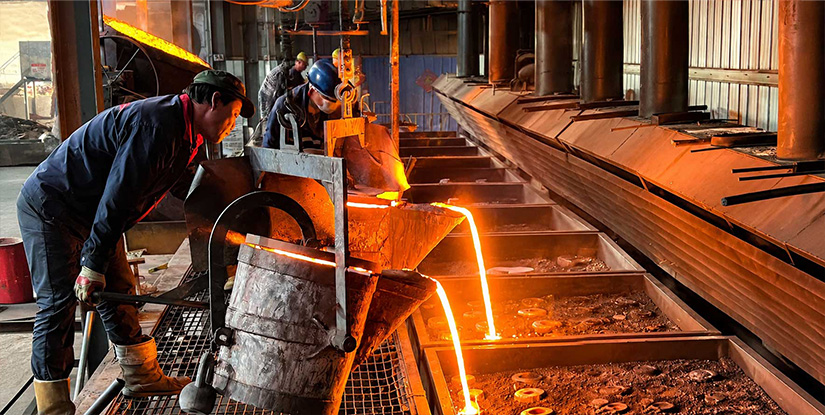
Long-term clients do not stay because of relationships. They stay because every time a shipment arrives, they think "fine, put it away." Every time a deadline approaches, they do not have to chase with "is it ready yet." Every time an issue comes up, they do not worry about "how long will this take to resolve." As a casting factory that values long-term partnerships, we have tested six dimensions over many years. These standards are not secrets. You can use them to evaluate any factory.
Related reading: Why Mass Production Differs from the Sample
Quality Consistency
The biggest cost of switching suppliers is rebuilding quality trust. Every shipment needs re-inspection. Sampling rates stay high. Inventory levels cannot be optimized. What truly reassures a client is not that the first batch was good. It is that the fifth batch looks identical to the first.
To achieve this, a casting factory needs to control three areas. Raw material batch traceability. Steel from different mills or different heats has different compositions. If the supplier changes, the product may change. Process parameter standardization. Pouring temperature, cooling time, shakeout time all affect casting density. Unstable parameters mean unstable weight tolerance. Finished product inspection standards. Fixed sampling rates. Any batch that fails sampling is reworked or scrapped.
We have built a traceability system from raw materials to finished products. Every batch of steel is tested for composition upon arrival. Different heats are stored and used separately. Each product has a process card documenting key parameters. Production follows the process card. Parameter changes require confirmation from both quality control and production management. Production records for each heat are archived and traceable by batch number.
Finished product inspection has three steps. First-article inspection confirms the mold is in good condition. In-process sampling checks appearance, dimensions, and weight at fixed intervals. Final inspection weighs every piece before packaging. Pieces outside tolerance are removed. Any batch that fails sampling is reworked. No exceptions.
The result is that clients do not need to inspect large sample sizes. A small sample is enough because this batch is the same as the last. Long-term clients stop raising weight tolerance issues. Not because they are lazy, but because no differences appear. Our inspection records are archived by batch number and available to clients at any time.
Delivery Reliability
Casting delivery times fluctuate. Molds wear out and need repair. Melting schedules are not always full. Post-processing capacity can fall short. Surface treatment subcontractors may delay. What clients fear most is not delay itself, but being notified at the last minute.
We have established a scheduling and tracking system that covers the entire process. Production schedules are updated regularly, showing planned dates for each order by product type. Clients can see where their order stands. Production progress is recorded daily. Every step from molding, melting, pouring, shakeout, grinding, heat treatment, machining to surface treatment has completion time records. When a client asks for status, we respond within our committed time.
Delivery delay alerts are standard procedure. If we determine that an order cannot meet the original delivery date, we notify the client in advance, not on the delivery date itself. We provide a revised delivery estimate and the reason for the delay. The client can adjust their inventory planning and downstream delivery arrangements accordingly.
Our standard is simple. Commit to delivery dates we can meet. Communicate early when we cannot. A delivery commitment is a commitment. Our past delivery records are available for clients to review.
Two-Tier Quality Control System
The biggest risk in casting quality control is self-inspection. When production lines are under pressure to meet output targets, inspection standards tend to relax. So we split quality control into two tiers. One at the factory level. One at the corporate quality department. The two tiers operate independently and check each other.
Factory QC: The Gatekeeper at Production Level
Factory QC reports to the production department, but their performance metrics are not tied to output volume. Their job is to find problems during production and stop the line when necessary. Factory QC handles three checkpoints.
First, incoming material inspection. Every batch of steel is sampled and tested for composition before acceptance. Steel with visible surface defects is rejected. Sand, binders, and other consumables are also sampled and tested. Non-conforming materials are not accepted into inventory.
Second, in-process inspection. Molding checks sand hardness, coating thickness, and gate placement. Melting checks each heat before pouring to confirm composition. Castings are inspected after pouring. Defective pieces are removed before moving to the next stage. Grinding, heat treatment, machining, and surface treatment each have their own inspection standards and records.
Third, finished product inspection. Before packaging, every piece is visually inspected and weighed. Pieces outside weight tolerance are separated. A fixed percentage of each batch is sampled for full dimension inspection and hardness testing. All inspection data is recorded and archived by batch number.
Corporate QC: Independent Supervisor
Factory QC reports to production. It has a natural blind spot. The corporate quality department is the independent second line of defense. They do not report to production. They report directly to corporate management. Their job is to verify that factory QC is not cutting corners.
Corporate QC works through unannounced spot checks. They show up without notice and pull samples from packed, ready-to-ship finished goods. Sampling rates and test items are stricter than factory QC. In addition to routine tests, they send samples to third-party labs for destructive testing.
If corporate QC finds a non-conforming batch, the process is as follows. Shipment of that batch is stopped immediately. If already shipped, a recall is initiated. Production records and factory QC records for that batch are pulled. The factory QC manager must submit a written corrective action report. The non-conforming batch is not counted in factory QC's pass rate statistics, preventing production from hiding problems.
The result is that every batch clients receive has effectively passed two independent inspections. One by factory QC. One by corporate QC. Under this system, production has no incentive to lower standards because corporate QC could show up at any time. Clients do not need to supervise production themselves. Our quality control system does it for them. When you visit our factory, we can arrange for you to meet both the factory QC manager and the corporate QC manager.
Problem Resolution Capability
Casting has no zero defects. The industry has a certain defect rate. We keep our defect rate low through continuous improvement, but it is not zero. Clients do not fear defects. They fear suppliers who shift blame, delay responses, or disappear when problems arise.
Our problem resolution process has four steps. Each step has clear time commitments and responsible parties. Clients do not need to guess when an issue will be resolved. We tell them.
Step one, confirm the problem. The client provides photos, videos, or samples. Factory QC confirms within the agreed timeframe whether it is a quality issue. Cosmetic defects that do not affect use are discussed with the client. If accepted, the shipment proceeds. Functional or safety defects trigger the formal resolution process.
Step two, analyze the cause. The quality department pulls production records for the affected batch. They trace back to the specific heat, mold, and shift. The root cause must be clearly identified as raw material, process, or operator error. The analysis report is completed within the agreed timeframe. If the issue involves a subcontractor, we require them to provide their production and inspection records.
Step three, propose a solution. Based on severity and client preference, we offer options. Replacement. Expedited production of replacement pieces with priority scheduling. Return. Client returns defective pieces for full refund. Discount. If the issue does not affect function but the client is dissatisfied, we negotiate a discount. The client chooses. We execute.
Step four, complete compensation. Expedited shipping costs for replacements are borne by us. Refunds for returns are processed within the agreed timeframe. Discounts are applied directly to the next order.
In past quality issues, our principle has been to resolve first, analyze second. We do not leave clients waiting in the middle. Clients have not switched suppliers because of these issues. Not because we are perfect. Because we resolved problems faster than they expected.
Related reading: What Makes a Power Rack Commercial Grade
Continuous Improvement
Clients stay for the long term because the factory gets better, not just stays the same. For long-term clients, we continuously improve across multiple dimensions. These improvements are not client requests. They are goals we set for ourselves. Clients do not directly say "I want your quality to improve every year." But they notice the changes.
In weight control, we have tightened weight tolerance ranges through mold precision upgrades, weighing equipment updates, and operator training. In surface treatment, we have improved pretreatment processes and enhanced coating adhesion and corrosion resistance. In delivery, we have shortened production cycles and improved on-time delivery rates through schedule optimization and capacity buffers. In defect rates, we have reduced defect rates across every process through in-process controls and yield tracking.
The paths to these improvements vary. Mold manufacturing upgraded from conventional machining to CNC. Weighing equipment upgraded to higher precision. Operators trained regularly and certified before working on the line. Pretreatment upgraded from simple degreasing to a full pickling and phosphating line. Scheduling software optimized. Capacity buffers reserved at bottleneck processes. Yield tracked for every process. Any process falling below target is stopped for root cause analysis.
Clients do not need to care about these processes. But we do. Because when renewal comes, clients may ask "what has improved since last year?" We need to answer that question. Compare this year's test reports with last year's. The changes in the data are clear. Clients do not always ask for these reports. But when we proactively show them, they notice.
Transparency in Partnership
Information opacity is the biggest source of client anxiety about casting factories. Clients do not know where their order stands in the schedule. They do not know the defect rate. They do not know where the raw materials come from. They do not know how busy the factory is. More transparency means less anxiety. We share what we can. When we cannot, we explain why.
Raw material sources. Mill name, grade, heat number. We show clients when they ask. Not every batch needs to be checked, but the information is available on request. Third-party test reports for major raw materials are updated periodically and shared with long-term clients proactively.
Test reports. Chemical composition, hardness, and weight data for each batch are archived and available for client lookup by batch number. Final inspection reports are shipped with each order. Clients see the test data when they receive the goods.
Defect rates. We periodically summarize non-conforming batches and how they were handled. We do not sugarcoat the numbers. Clients can see what went wrong, how we resolved it, and how we improved afterward. These summaries are not client requests. We do them because we need them to track our own improvement.
Capacity load. Clients can see where their order stands in the queue. When capacity approaches saturation, we proactively inform clients that delivery times may extend. When a client has a rush order, we provide a clear expediting plan and timeline, not a vague "we will try."
Factory visits. When clients want to see the shop floor, we arrange visits. The tour covers raw material storage, casting lines, machining shops, surface treatment lines, quality labs, and finished goods storage. Clients can take photos, talk to line workers, and see anything that is not confidential.
For long-term clients, we share more. Quality reports, capacity plans, equipment investment plans. These help clients with their own procurement planning and budgeting. Long-term partnerships are not built on a single factory visit. They are built on every time the client wants to see something and finds it available. Trust is a byproduct of transparency, not a goal in itself.
Long-Term Partnerships Are Built Shipment by Shipment
Long-term clients do not switch suppliers. Not because they are lazy. Because every shipment, every delivery, every after-sales interaction gives them no reason to switch.
These six dimensions are not secrets. Quality consistency. Delivery reliability. Two-tier quality control. Problem resolution capability. Continuous improvement. Transparency. You can use them to evaluate any factory. What we claim, you can verify. What we miss, you can tell us.
If you are evaluating suppliers, you do not need to wait years to trust a factory. Use these six dimensions to verify. Factories will show you through their actions. Our test records, delivery data, and quality issue reports are available. You can come to see them. You can send someone to stay at our factory. The more transparent, the simpler.
Related reading: Professional Fitness Equipment Manufacturer Certifications