

How Many Kettlebell Sizes a Gym Actually Needs
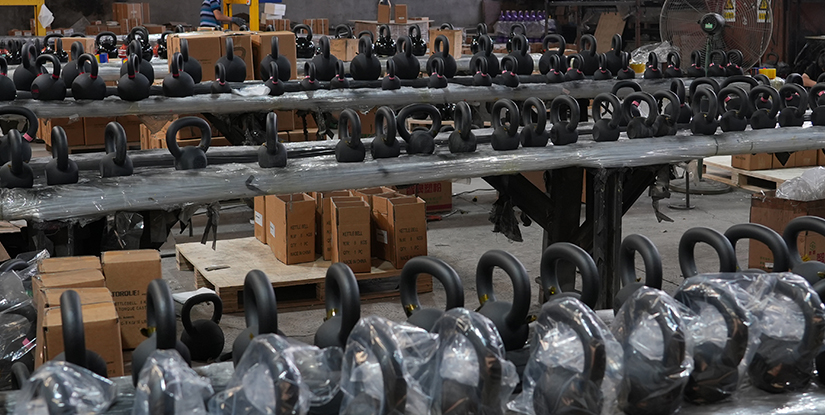
Ask a dealer or a trainer how many kettlebell sizes a gym needs, and the answer is usually "it depends." But our factory shipping data tells a different story. Most gyms get it wrong. Not the wrong sizes. The wrong quantity ratios. Light weights gather dust. Mid-range weights run out. Heavy weights sit untouched for months. This article starts from the manufacturing side. Casting processes. Weight tolerances. Surface finishes. Production data. And answers the question again, properly.
What Factory Shipping Data Reveals About Real Demand
Over the past several years, we have recorded the size distribution of every bulk order. The result is clear. The three sizes of 8kg, 12kg, and 16kg account for over sixty percent of total shipments. The 4kg and 6kg sizes together account for less than fifteen percent. Sizes above 20kg account for less than ten percent. The remaining fifteen percent is split between 10kg and sizes above 24kg.
What does this mean? There is a significant gap between what gyms order and what they actually use. In many orders, the quantity of 4kg and 6kg is too high. Six months after opening, these light kettlebells sit idle. Meanwhile, the mid-range sizes from 8kg to 16kg run out three months after opening. Procurement is not about collecting the full set. It is about matching actual load demand.
One-Piece Casting Is the Baseline, Not a Selling Point
Commercial kettlebells must be cast as a single piece. The body, the handle, and the base must be poured in one shot. No welds anywhere. This requirement sounds basic, but many products on the market still fail to meet it.
The way to tell is simple. Look at where the handle meets the body. A one-piece casting has a smooth transition with no visible seam line. A welded handle has a ring of grinding marks around the joint, or a faint circular depression under the coating. You can also feel it with your fingers. After six months to a year of use, welded kettlebells develop fine cracks at the weld, then suddenly break. This is not a quality defect. It is a structural design that was wrong from the start.
Casting processes also differ. Green sand casting is low cost, but produces rough surfaces, porous castings, and poor weight consistency. Resin sand casting has higher mold precision, smoother surfaces, and better dimensional stability. Centrifugal casting achieves the highest density, but requires significant equipment investment. Commercial kettlebells should use at least resin sand casting or a better process.
Weight Tolerance: ±3% Is Industry Minimum, ±1% Is Commercial Standard
Kettlebells are solid cast iron. Weight is determined by mold cavity size and molten iron density. Every batch has weight variation. The question is how the factory controls that variation.
The industry standard is ±3 percent. A kettlebell labeled 16kg can weigh anywhere between 15.52kg and 16.48kg and still be considered acceptable. But this tolerance is too wide for commercial use. When members use multiple kettlebells at the same time, two bells both labeled 16kg but weighing 15.6kg and 16.4kg feel completely different in hand. For distributors, excessive weight variation hurts their ability to sell matched pairs.
Internal control standards should achieve ±1 percent. A 16kg kettlebell should weigh between 15.84kg and 16.16kg. This is not luck. It comes from process control. Samples are weighed from each batch. Mold parameters or pouring parameters are adjusted based on actual weights. Every piece is weighed before leaving the factory. Outliers are reworked or downgraded. Ask your supplier three questions. What is your internal weight tolerance? What is your batch sampling rate? Is every piece weighed before shipment? If they cannot answer, assume ±3 percent.
Surface Finish: Coating Is Not Color, It Is Protection
Coating has three jobs. Rust prevention. Grip feel. Appearance. The order matters. Many buyers look only at color and ignore rust protection entirely.
E-coat is the current standard for commercial kettlebells. It offers better adhesion and salt spray resistance than standard powder coating. Neutral salt spray testing should reach 96 hours or more with no red rust. Standard powder coating may only achieve 48 hours. The difference is visible. E-coat surfaces are smooth and uniform, with complete edge coverage. Poor coatings show bare spots or runs on edges and inside the handle.
Coating coverage inside the handle is the most overlooked blind spot. Many kettlebells have thin or no coating on the inner surface of the handle. This is where sweat accumulates. This is also where rust starts first. Shine a bright flashlight inside the handle. Check for complete coating coverage. If the inside is bare iron or has obvious coating defects, rust will start there within six months.
Bare iron kettlebells are not recommended for commercial use. They feel best in hand, but require daily wiping and maintenance. In a commercial environment, that almost never happens. Bare iron quickly becomes rusty iron.
Handle Geometry: Every Millimeter Affects the Feel
The handle shape is the part of the kettlebell that shows the most engineering experience. Opening height. Opening width. Cross-section profile. Surface texture. Every detail affects grip comfort and safety.
Opening height determines whether your hand fits easily. Too low, and gloves feel cramped. Too high, and the center of mass shifts too far. For kettlebells up to 16kg, an opening height of 50 to 55 millimeters is a comfortable range.
Opening width affects grip stability. Too narrow, and your hand feels stuck. Too wide, and you cannot hold securely. Between 65 and 70 millimeters is a well-validated range. Smaller widths require more wrist control.
The handle cross-section should be a D shape. Flat on the bottom, curved on top. The flat side faces the fingers. The curved side faces the palm. This design distributes pressure evenly and avoids localized pain. Cheap kettlebells have round or oval handle sections. After a few minutes of gripping, your palm shows red marks.
Surface texture also matters. Too smooth, and the handle slips when your hands sweat. Too rough, and it tears up your hands. A quality kettlebell handle has a fine matte texture. It grips without slipping. It does not tear skin. Suppliers will not put these specs on a data sheet. You have to feel it yourself. Put your hand through the handle. Hold it. Do a few practice swings. Feel if the edges dig in. Check for burrs on the inside. See if your hand feels comfortable.
The Flat Bottom Test: Five Seconds to Check Base Flatness
The bottom of the kettlebell is the only part that touches the floor. If the bottom is not flat, the kettlebell will not stand steady. Every time you put it down, you have to adjust its position.
The test is simple. Place the kettlebell on a flat glass or granite surface. Give it a light push. If it spins on its own, the bottom is not a flat plane. There is a high point somewhere. A quality kettlebell has a fully flat bottom. It sits motionless on the surface. You can also use a feeler gauge to measure the gap between the bottom and the surface. Any gap over 0.5 millimeters is a failure.
The cause of an uneven bottom is skipping the base grinding step after casting. This step adds cost without improving appearance. Many factories skip it. In commercial procurement, this detail is worth checking. Turn the kettlebell over and look at the bottom. A ground bottom shows uniform sanding marks. An unground bottom shows rough as-cast skin.
Related reading: Professional Fitness Equipment Manufacturer Certifications
Kettlebell Configuration by Gym Size
| Facility Type | Recommended Sizes (kg) | Quantity per Size | Estimated Total Units |
|---|---|---|---|
| Small Boutique Studio | 6, 8, 10, 12, 16 | 4 to 6 per size | 20 to 30 |
| Mid-Size Commercial Gym | 4, 6, 8, 10, 12, 14, 16, 20, 24 | 6 to 8 per size | 54 to 72 |
| Large Fitness Center | 4, 6, 8, 10, 12, 14, 16, 18, 20, 24, 28, 32 | 8 to 12 per size | 96 to 144 |
Note that 4kg is not listed. Among the light weight range, 4kg has the lowest usage frequency. Most users start directly at 6kg or 8kg. If budget is tight, 4kg can be skipped. Also note the 14kg and 18kg sizes. These fill the gaps between 12 and 16, and between 16 and 20. User feedback on these sizes has been very positive. But many suppliers do not produce them.
Receiving Inspection: Checks the Factory Will Not Do For You
When kettlebells arrive, there are several checks worth doing. Do not wait until they are on the floor to find problems.
Weight sampling. Randomly sample ten percent of each batch. Weigh each sample on a calibrated scale. Calculate the deviation from the labeled weight. If more than five percent of samples exceed ±1 percent deviation, the entire batch needs re-evaluation.
Handle inspection. Run your hand around the inside and outside of the handle. Feel for burrs, sharp edges, or casting defects. Run one finger along the inner surface of the handle. Any rough spot worth sanding should be noted.
Coating inspection. Use a bright light to examine the entire surface, especially the inside of the handle and the bottom edges. Look for bare spots, bubbles, or peeling. Coating adhesion can be tested with a utility knife. Cut a cross in the coating. Apply tape and pull. The coating should not come off in large pieces.
Base flatness check. Place the kettlebell on a flat surface. See if it sits steady. Give it a light push. See if it spins on its own.
These checks require no special equipment. Just ten minutes and your hands. The factory does sampling before shipment. They will not do full inspection for you. Receiving inspection is your own responsibility.
Summary: Eight to Ten Sizes, Plus an Inspection Standard
Most commercial gyms need eight to ten kettlebell sizes. From 4kg to 24kg, focus on the mid-range sizes of 6, 8, 10, 12, 14, and 16kg. Buy sufficient quantities of these. 4kg can be limited or skipped entirely. For sizes above 20kg, buy small quantities and add more gradually based on actual use.
But weight configuration is only half the answer. The quality of the kettlebells themselves matters just as much. One-piece casting. ±1 percent weight tolerance. 96-hour salt spray tested coating. Proper handle geometry. Flat bottom. These are the standards commercial kettlebells should meet. Without these, even the perfect weight configuration is waste. Procurement is not about reading spec sheets. It is about setting clear standards before the factory ships and doing proper inspection when the order arrives.
Related reading: Identifying the Best Fitness Manufacturer for Commercial Use