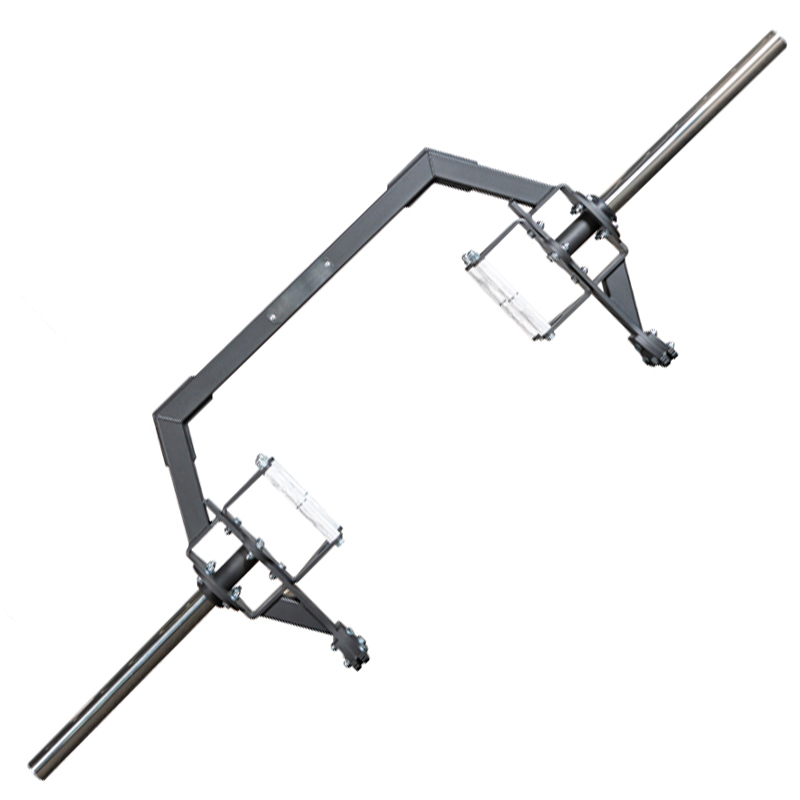
The adjustable safety squat bar represents a significant evolution in specialty bar design, addressing a fundamental limitation of traditional safety squat bars: the fixed pad angle and camber position. Unlike standard safety squat bars that lock the user into a single mechanical path, an adjustable variant allows the lifter to modify the pad orientation, camber depth, or handle angle to accommodate individual anthropometry, injury limitations, or specific training goals.
Traditional safety squat bars have long been valued for their ability to shift the load center of gravity forward, reducing shear stress on the lower back while increasing quadriceps activation. However, their one-size-fits-all geometry creates problems for athletes with atypical torso lengths, shoulder mobility restrictions, or previous injuries. A lifter with limited shoulder external rotation may find the fixed handles impossible to grip comfortably, while a taller athlete may experience the camber digging into their traps at the wrong contact point. The adjustable safety squat bar solves these mismatches through modular or tool-less adjustment mechanisms.
The engineering behind adjustability typically falls into three categories. Pad angle adjustment allows the shoulder pads to rotate along the yoke, enabling the lifter to find the sweet spot between trap pressure and anterior delt engagement. Camber depth adjustment changes how far the weight plates sit forward of the lifter's centerline—a deeper camber increases quad demand, while a shallower camber reduces forward lean requirements. Handle position adjustment offers multiple vertical and horizontal grip locations, accommodating lifters with wrist injuries, elbow tendinopathy, or simply different arm lengths. The highest-end designs allow all three adjustments without tools, using spring-loaded pins or cam-lock mechanisms.
For facility operators and serious home gym owners, the adjustable safety squat bar delivers a measurable return on investment. Instead of purchasing multiple specialty bars (a standard SSB, a cambered squat bar, and possibly a football bar for shoulder-friendly pressing), a single adjustable unit covers the same movement spectrum. This space efficiency matters in commercial environments where floor space carries a direct cost. More importantly, adjustability future-proofs the investment: if a member recovers from shoulder surgery or a coach changes training methodology, the same bar adapts without replacement.
When evaluating adjustable safety squat bars for procurement, three quality indicators separate durable units from problematic ones. First, the adjustment mechanism must use positive locking with secondary retention—spring-loaded pins alone are insufficient; look for locking collars or detent balls that prevent unintended movement under heavy load. Second, the yoke-to-sleeve connection should be welded, not bolted, with gusset reinforcement at stress corners. Third, the pad density matters: 90% of complaints about adjustable SSBs trace back to under-filled pads that compress to hard plastic within months. Commercial-grade pads use closed-cell foam or dual-density rubber with a minimum 40mm thickness.
The weight of an adjustable safety squat bar typically exceeds its fixed counterpart due to the additional hardware required for adjustability. A standard SSB weighs approximately 25kg to 30kg, while an adjustable version often reaches 32kg to 38kg. This extra weight is not a design flaw—it reflects the added steel in locking mechanisms, thicker yoke walls, and reinforced pivot points. Lifters accustomed to lighter specialty bars should expect an adjustment period, but the increased stability during heavy squats is a legitimate benefit.
From a biomechanical perspective, the adjustable safety squat bar unlocks training variations that are otherwise difficult to achieve. Setting the pads to a more neutral angle reduces shear on the cervical spine, beneficial for lifters with disc issues. Rotating the camber to its shallowest setting approximates a high-bar squat pattern, preserving specificity for competition lifters during rehab periods. Widening the handle stance reduces shoulder impingement, allowing overhead athletes to maintain squat strength without aggravating rotator cuff pathology. These modifications transform the safety squat bar from a remedial tool into a versatile primary training implement.

Let our experts design the perfect gym solution for your business. Get a free consultation and quote today.