
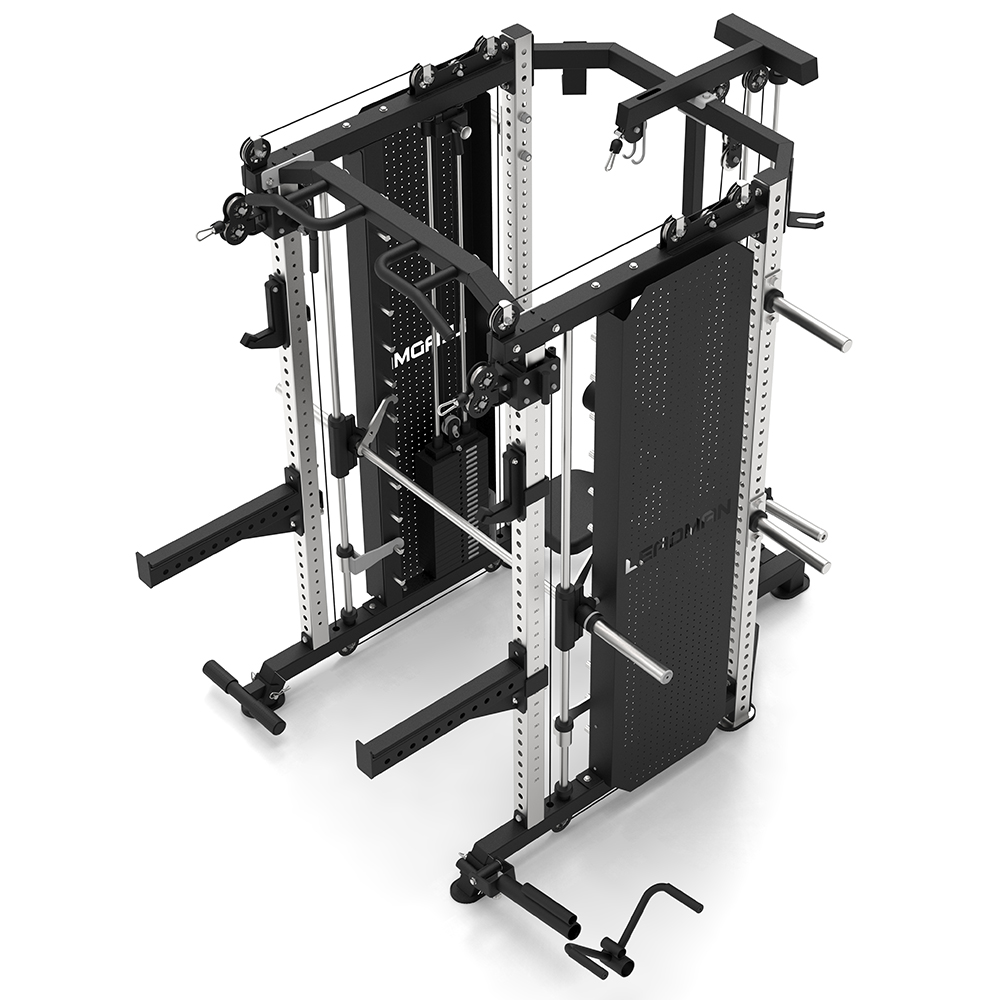
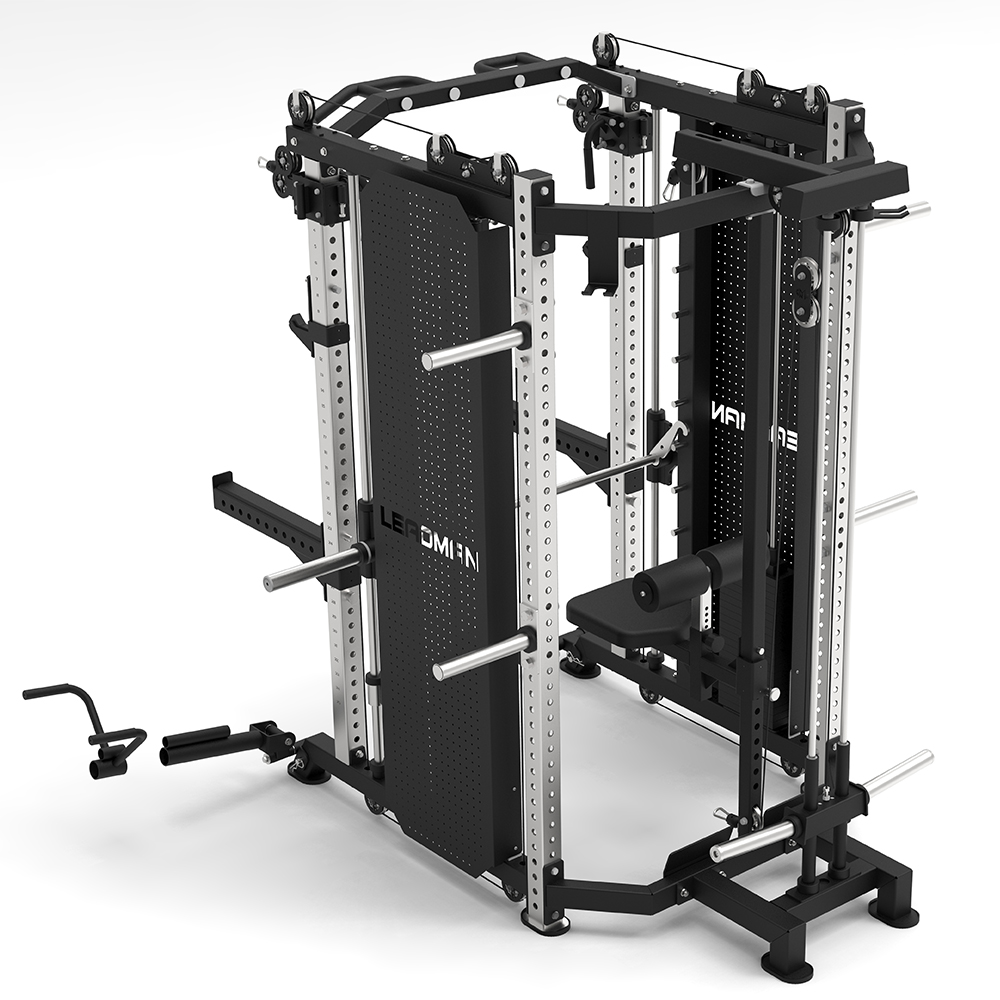
Walk into any commercial gym, and you will see the same inefficiency repeated across the floor: a Smith machine here, a lat pulldown there, a functional trainer in the corner, a leg curl tucked against the wall. Each piece occupies its own footprint. Each piece serves one primary function. The 9001 All-in-One Functional Training System collapses this sprawl into a single, integrated station. This is not a power rack with a few attachments. It is a complete strength ecosystem built around an F75×3mm steel frame, designed to support Smith machine work, cable training, plate-loaded resistance, pull-ups, landmine exercises, and dedicated leg isolation—all within a footprint barely larger than a standard rack.
From an operator's perspective, the 9001 solves two persistent problems: equipment redundancy and underutilized floor space. A facility that installs two or three of these units can retire six to eight single-function machines, freeing up hundreds of square feet for other revenue-generating activities like group training or retail. More importantly, members no longer wait for equipment. If one station is occupied, the user can move to a different attachment point on the same rack rather than standing idle. This throughput efficiency directly improves member satisfaction and retention.
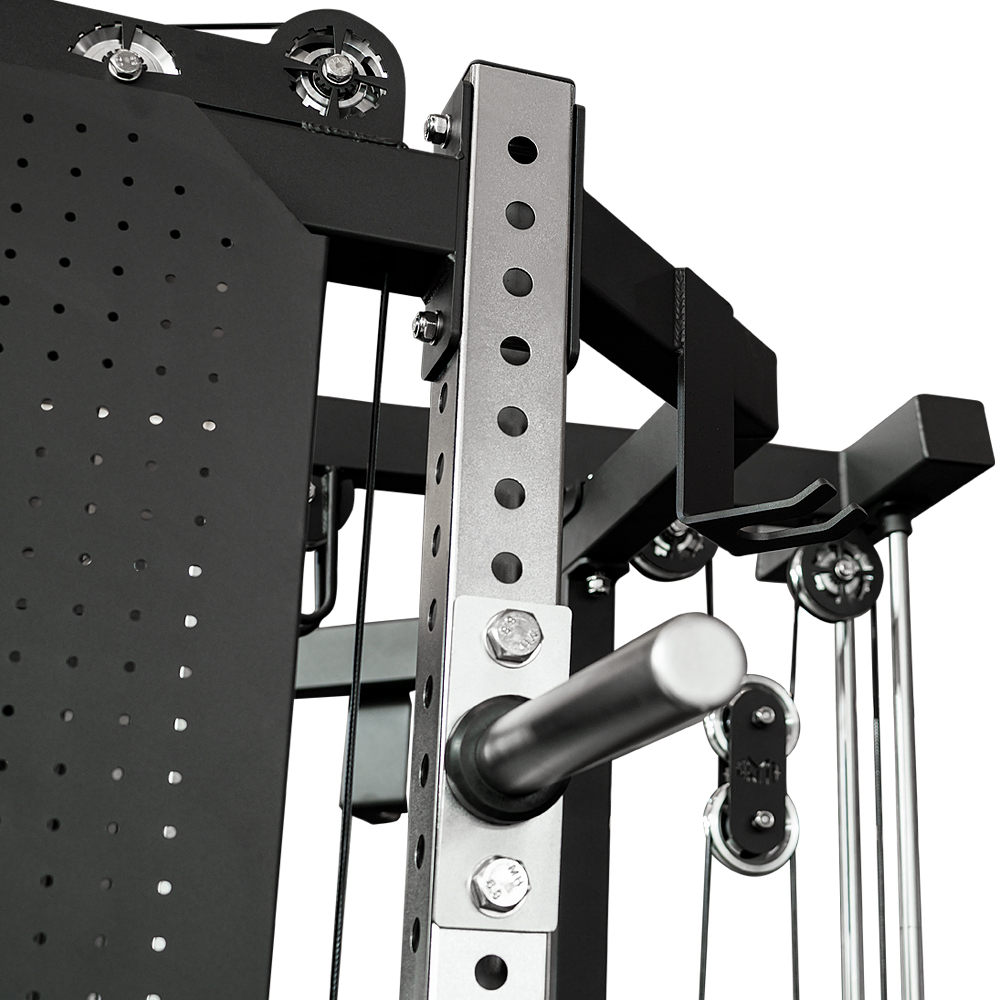
The most common failure point in multi-function racks is insufficient steel. When a manufacturer uses thinner tubing to reduce cost, the frame flexes under load. That flex translates to the Smith guide rods, causing them to bow slightly during a heavy squat. The result is a sticky or grinding sensation as the bar travels. The 9001 starts with F75×3mm thickened square tubing on all four uprights. The 75mm dimension provides a wide flange for attaching accessories. The 3mm wall thickness ensures the column does not twist or bend even when loaded with 200kg of plates plus a 150kg user performing explosive movements.
The 30mm Smith guide rods represent another tier of engineering. Standard guide rods measure 25mm or 28mm in diameter. The jump to 30mm increases cross-sectional area by roughly 44 percent compared to 25mm rods. This additional material dramatically reduces bending moment under load. More importantly, it increases the wear surface. Over years of use, guide rods develop grooves where the bushings travel. Thinner rods groove faster. The 30mm rods on the 9001 extend service intervals significantly, reducing maintenance costs over the life of the equipment.
The phrase "zero offset, zero shake" is not marketing hyperbole. It describes the relationship between the guide rods, the linear bearings, and the frame. Offset refers to lateral movement—the bar shifting side to side during a squat. Shake refers to oscillation—the bar vibrating at the top or bottom of the movement. Both are eliminated when the frame is stiff enough and the rods are thick enough to resist deformation. For the user, this means every rep feels identical to the last. For the facility, it means fewer complaints about equipment quality.
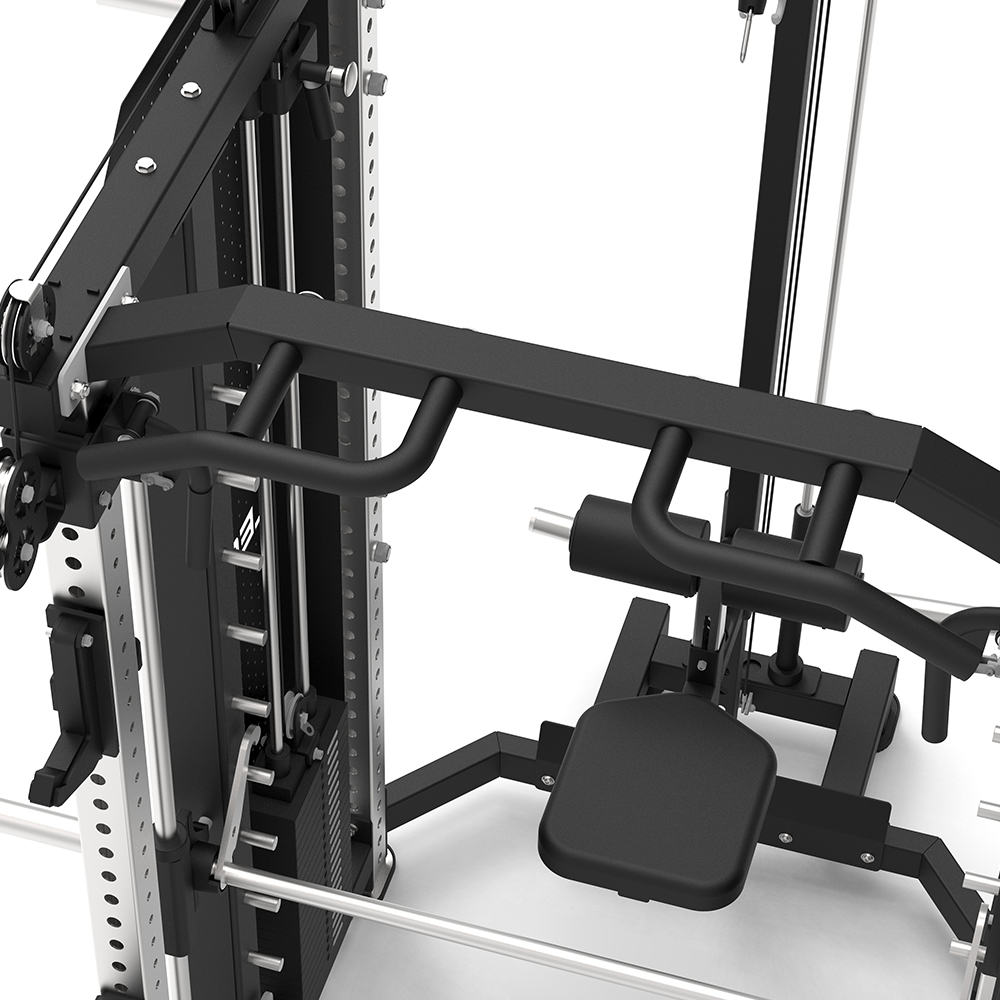
The pull-up bar is often an afterthought on multi-function racks—a simple straight tube welded across the top. The 9001 uses Φ32 multi-angle handles instead. The 32mm diameter is a deliberate choice based on hand anthropometry. A 25mm bar (common on cheap racks) forces the fingers into a more closed position, increasing forearm fatigue and risking tendonitis in high-volume users. A 38mm bar is too thick for smaller hands, reducing grip security and limiting rep counts. The 32mm diameter accommodates the widest range of hand sizes while still allowing a secure, non-slip grip.
The multi-angle design includes neutral, pronated, and supinated grip positions. Each grip changes the muscle recruitment pattern. Neutral grip (palms facing each other) shifts emphasis to the brachialis and brachioradialis, building forearm and elbow flexion strength. Wide pronated grip maximizes latissimus dorsi activation but increases shoulder impingement risk in some users. Close supinated grip (chin-up position) loads the biceps brachii heavily. By providing all three options on the same bar, the 9001 allows users to vary their training stimulus without changing equipment.
The non-slip surface is achieved through precision knurling rather than rubber sleeves or tape. This is a commercial-grade decision. Rubber degrades under UV light, absorbs sweat and cleaning chemicals, and eventually becomes sticky or brittle. Tape peels. Knurling lasts for the life of the steel. The knurling pattern on the 9001 is moderate—aggressive enough to secure a grip during high-rep sets but not so sharp that it tears calluses or requires chalk.
| Grip Type | Primary Movers | Secondary Movers | Joint Stress Profile |
|---|---|---|---|
| Wide Pronated | Latissimus dorsi | Teres major, rear deltoid | Higher shoulder impingement risk |
| Shoulder-Width Neutral | Brachialis, brachioradialis | Lower lats, rhomboids | Lowest elbow and shoulder stress |
| Close Supinated | Biceps brachii | Upper lats, pectoralis major | Moderate bicep tendon load |
The rowing footplate and landmine receiver are often overlooked in marketing materials, but experienced facility managers recognize them as high-value additions. The footplate provides a fixed bracing surface for seated cable rows. Without a footplate, users must brace their feet against the floor or the rack's base, which allows the torso to move during the pull. This torso movement reduces isolation of the back muscles and increases lumbar shear forces. The footplate eliminates both problems by giving the user a solid, angled surface to push against.
The landmine receiver accepts a standard landmine post (sold separately), turning the rack into a rotational training station. Landmine exercises are unique because they combine axial loading with an arc-shaped movement path. A landmine press, for example, loads the shoulder through a natural diagonal arc rather than a straight vertical or horizontal line. This reduces impingement risk while still allowing heavy loading. Landmine rows allow single-arm pulling without the stability demands of a one-arm dumbbell row. Landmine twists train the oblique slings for rotational sports like golf, baseball, and tennis.
From a programming perspective, the landmine is one of the few implements that can safely load the core in rotation. Most core exercises (crunches, planks, leg raises) train anti-extension or anti-rotation. Landmine twists train actual rotation through a loaded range of motion. This is essential for athletes who need to generate rotational power. For general population clients, it builds functional stability for everyday movements like lifting and carrying.
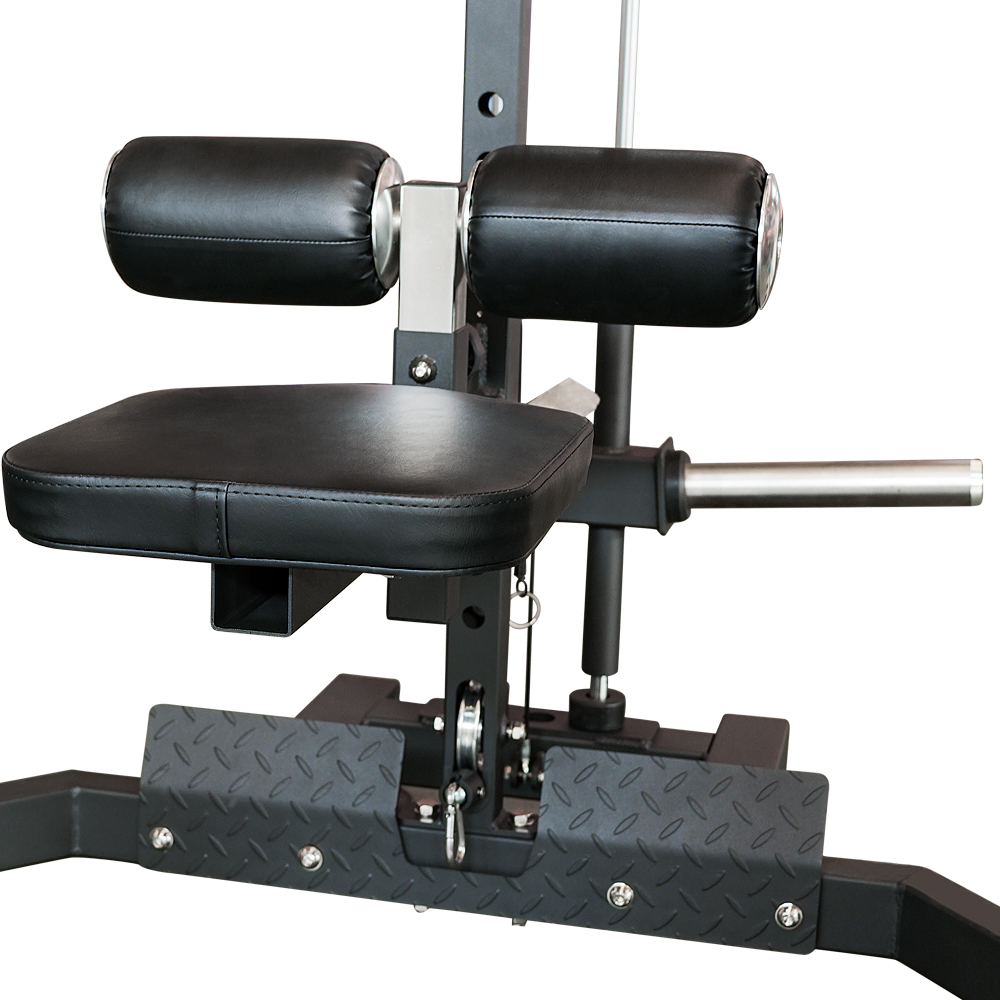
Many all-in-one racks treat the cable seat as an afterthought—a simple pad that slides up and down the upright with little consideration for biomechanics. The 9001 includes a dedicated high and low pull seat designed specifically for cable exercises. For lat pulldowns, the seat positions the user so the thighs lock under the leg foam at the correct height. That height matters because it determines how much the latissimus can stretch at the top of the movement. If the seat is too low, the user cannot achieve full shoulder elevation. If it is too high, the weight stack bottoms out before the lats are fully stretched.
For low rows, the seat shifts to a lower position, and the chest pad swings into place. The chest pad serves a critical function: it prevents the torso from moving backward during the pull. When the torso moves, momentum assists the lift, reducing muscle activation in the back. The chest pad eliminates momentum by creating a fixed pivot point at the sternum. The result is a true isolation movement where the latissimus and rhomboids do all the work.
The leg foam itself is a commercial-grade material. It uses a dense closed-cell foam wrapped in vinyl that meets CA TB 117-2013 flammability standards. Closed-cell foam does not absorb sweat or cleaning fluids, preventing bacterial growth and material breakdown. The vinyl surface is non-slip even when wet, keeping the user's legs secure during heavy pulls. For facilities that clean equipment multiple times per day, this material choice extends the life of the padding significantly compared to open-cell foams.
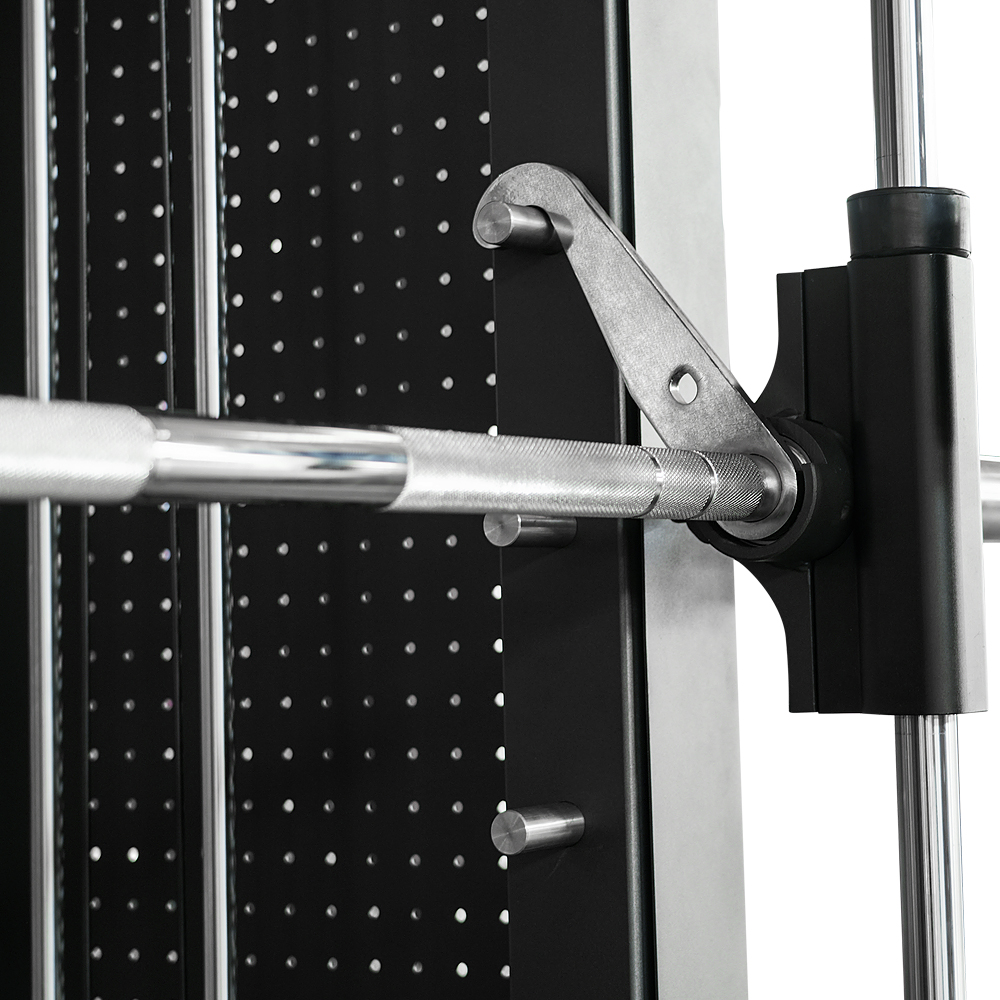
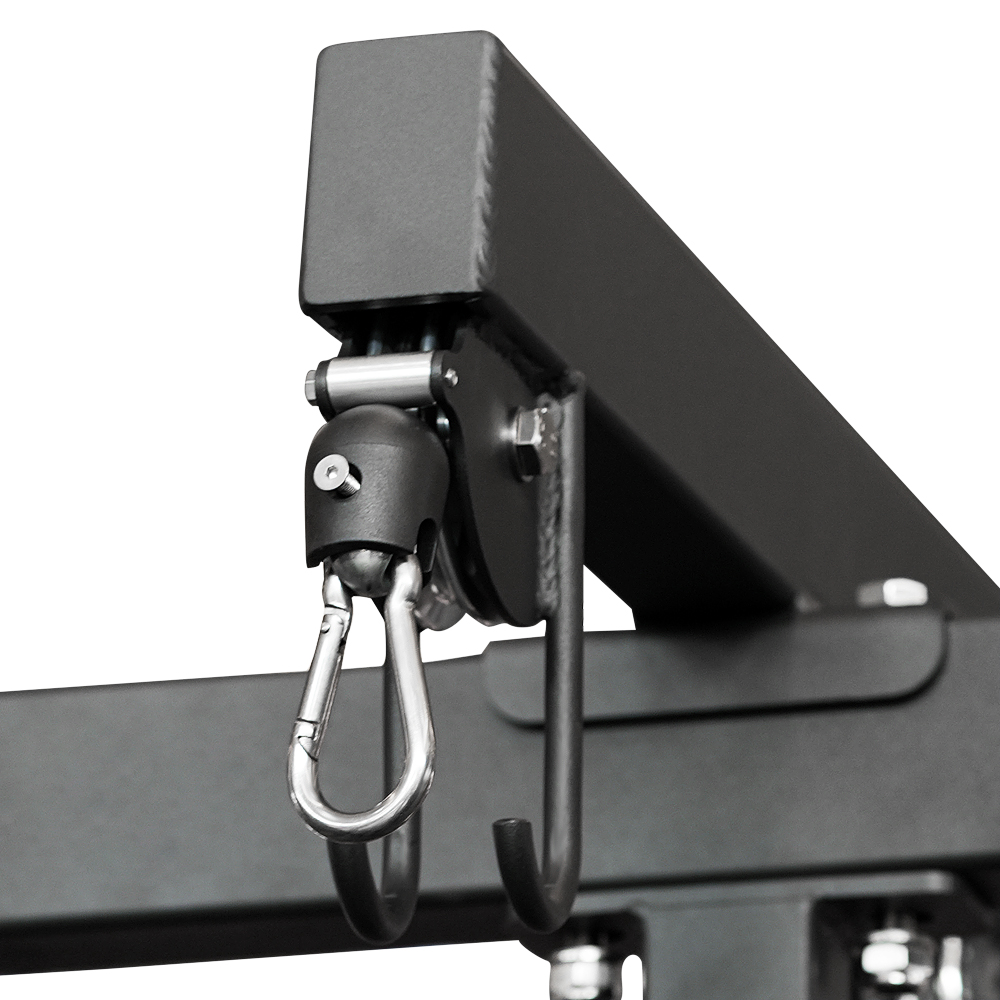
Safety is not a single feature on the 9001; it is a redundant system. The Smith machine uses safety catch hooks that engage with the 30mm guide rods. These hooks are machined from solid steel rather than stamped from sheet metal. Stamped hooks can shear along the grain of the metal if subjected to a sudden drop. Machined hooks have a uniform grain structure and are significantly stronger. The hooks interface with notches cut into the guide rods. When the user rotates the bar, the hooks drop into the nearest notch, catching the bar within inches of travel.
The sandwich hooks are a separate safety system for free-weight exercises performed on the external uprights. Traditional J-hooks have a single lip that catches the barbell. If the user racks the bar with an upward motion, the bar can bounce out of the hook. Sandwich hooks have two lips: a lower lip that supports the bar and an upper lip that prevents upward dislodgement. The "sandwich" name comes from the bar being held between the two lips. This design virtually eliminates bar-on-neck accidents during re-racking, which are a leading cause of gym liability claims.
Both safety systems work independently. A user performing Smith machine squats relies on the catch hooks. A user performing free-weight bench press on the spotter arms relies on the sandwich hooks. A user performing both in the same workout uses both systems. This redundancy is rare in all-in-one racks, where manufacturers often force a choice between Smith safety and free-weight safety. The 9001 provides both simultaneously, allowing facilities to serve all training styles without compromise.
| Exercise | Primary Safety System | Secondary Protection |
|---|---|---|
| Smith Machine Squat | Safety catch hooks on guide rods | Spotter arms (optional) |
| Free-Weight Bench Press | Sandwich hooks on spotter arms | Manual spotter |
| Free-Weight Squat | Sandwich hooks at shoulder height | Safety catch hooks (Smith mode not engaged) |
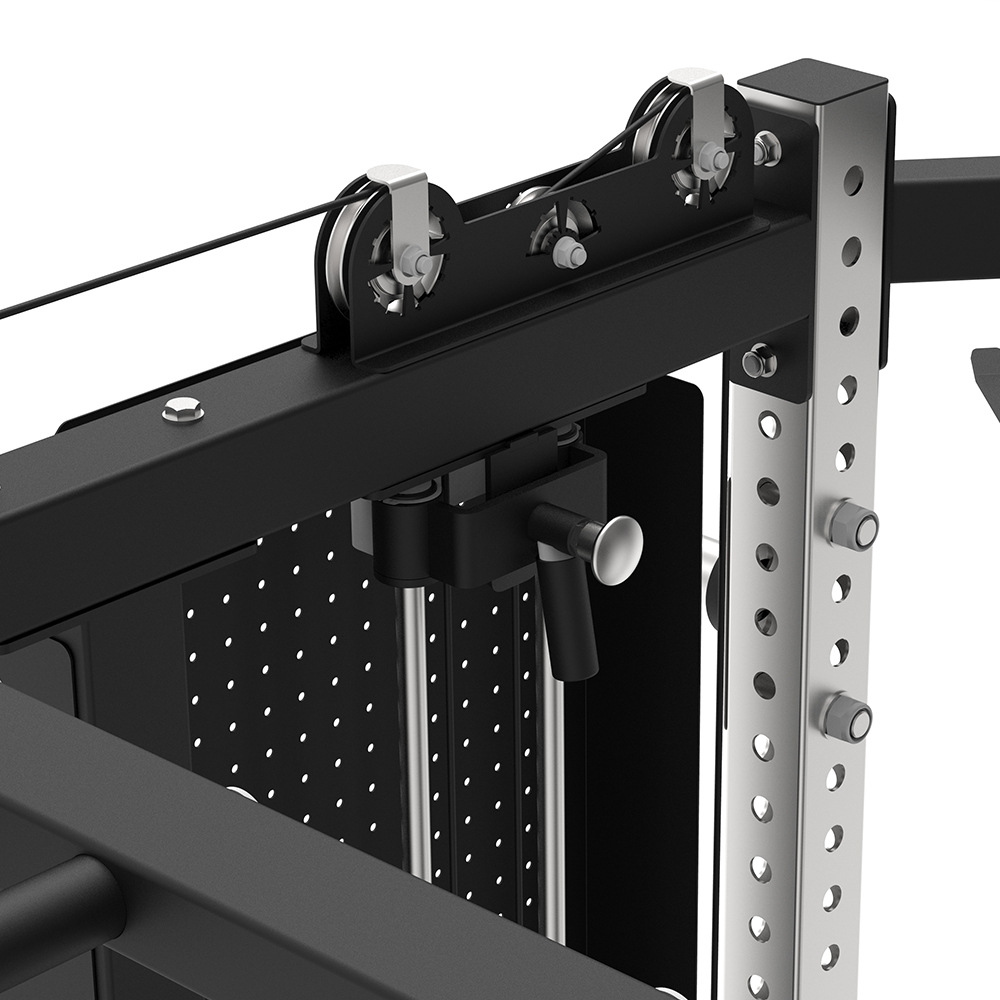
The cable system on the 9001 uses high-strength aluminum pulleys with precision bearings. Aluminum is chosen over nylon or steel for specific reasons. Nylon pulleys deform under sustained heavy loads, creating flat spots that cause the cable to jump or stick. Steel pulleys are heavy and, if not properly sealed, rust at the bearing race. Aluminum offers the ideal combination: lightweight to reduce rotational inertia, corrosion-resistant for humid environments, and dimensionally stable under load.
The precision bearings inside each pulley are the true performance differentiator. Standard bearings have a tolerance range that allows lateral play—the pulley can wobble slightly on its axle. That wobble translates to a "clunky" feel when the cable changes direction. The bearings in the 9001 are machined to tighter tolerances, eliminating lateral play. The result is what the manufacturer calls "ultra-smooth" operation. More importantly, the tight tolerances eliminate empty stroke—that dead zone at the beginning of a pull where the cable moves before engaging resistance.
Empty stroke is not just annoying; it is a safety issue. During explosive movements like cable woodchoppers or standing punches, the user generates momentum before resistance engages. When the cable suddenly catches, the joint experiences an abrupt load spike. Over time, this can contribute to tendonitis or joint irritation. The smooth linear rebound of the 9001's system ensures resistance is present from the first millimeter of cable travel. The return mechanism is calibrated to match pulley friction exactly, so the cable returns to its resting position at a controlled, predictable speed—no sagging, no snapping back.
Many buyers assume a built-in weight stack is superior to plate loading. The 9001 challenges that assumption. Plate loading offers three distinct advantages: cost, customization, and future-proofing. A weight stack adds significant manufacturing cost—typically $800 to $1,500 per machine. Plate loading passes those savings to the facility. More importantly, plate loading allows micro-loading. Weight stacks use selector pins that increase resistance in fixed increments, usually 5kg or 10lb. Plate loading allows 1.25kg or 2.5lb increments using fractional plates. For intermediate and advanced lifters, those small increments are essential for linear progression.
Customization extends to plate types. A facility that already owns competition bumper plates can use them on the 9001. A facility that prefers cast iron change plates can use those instead. The weight horns are designed to accept standard 50mm Olympic plates, the industry standard. There is no proprietary plate requirement. This flexibility also applies to future expansion. If a facility adds heavier plates over time, the 9001's resistance ceiling expands with it. A weight stack is fixed; once you max out the stack, the machine cannot provide more resistance without expensive retrofitting.
The weight horns themselves are engineered for safety and convenience. They are welded directly to the uprights rather than bolted. Welded attachments cannot loosen over time. The horns are positioned low on the frame to keep the center of mass close to the ground, reducing tipping risk. The spacing between horns accommodates multiple plate diameters simultaneously—a 450mm bumper plate and a 300mm iron plate can be stored on adjacent horns without interference.
Not every facility needs the full 9001 configuration on day one. The modular design allows operators to start with a base frame and add components over time. The base includes the four uprights, the Smith guide rods, the pull-up bar, and the basic cable system. From there, facilities can add the leg curl/extension unit, the landmine receiver, additional weight horns, or the dedicated high/low pull seat as budget allows. Each component attaches via standardized interfaces rather than generic bolts, ensuring proper alignment regardless of when it was added.
The DIY compatibility extends to assembly. Unlike some all-in-one racks that require professional installation, the 9001 ships in modular boxes that can be assembled by facility maintenance staff. The heaviest single component is the base frame, which can be moved with two people. All fasteners are standard metric sizes, so no special tools are required. For facilities opening on a tight timeline, this modular assembly reduces the wait time between delivery and first use.
Storage is also modular. The weight horns double as plate storage, eliminating the need for separate weight trees. The leg foam seats swing out of the way when not in use. The cable attachments store on dedicated pegs integrated into the frame. No extra storage rack required. For facilities with limited floor space, this integration is a significant advantage. Every square foot that would otherwise be occupied by a storage tree becomes usable training space.
The most expensive real estate in any commercial gym is the floor. Every piece of equipment occupies square footage that could otherwise generate revenue through personal training, group classes, or retail. The 9001's space efficiency is therefore not just a convenience—it is an economic advantage. A single 9001 unit replaces a Smith machine, a functional trainer, a lat pulldown, a leg curl, and a landmine station. Those five separate pieces would occupy between 80 and 120 square feet depending on layout. The 9001 occupies approximately 24 square feet (4 feet by 6 feet).
The space savings multiply across multiple units. A facility that installs four 9001 units instead of separate machines saves 200 to 350 square feet. That space can be converted into a group fitness area (adding $500 to $2,000 per month in revenue), a retail display (adding $300 to $1,000 per month in margin), or additional equipment (adding member value). From a real estate perspective, the 9001 effectively pays for itself through the square footage it does not consume.
Vertical integration is the mechanism behind this efficiency. Weight plates store on the uprights rather than on floor-based trees. Cables route internally through the frame rather than externally where they could be tripped over or damaged. The landmine receiver sits flush with the base plate. The leg foam seats fold vertically when not in use. Every component is designed to keep the floor clear and the footprint minimal.
In a busy commercial gym, every second counts. Members waiting for equipment are not working out. Trainers waiting for plate changes are not training. The 9001's plate-loaded design enables fast load selection through thoughtful horn placement. Weight plates slide on and off without requiring multiple collars. The Smith bar accepts plates directly. The cable loading pin accepts plates with a simple spring clip. A user can change the load on the Smith machine from 60kg to 100kg in under 20 seconds.
Fast load selection also enables circuit training and supersets. A trainer running a small group through a circuit can have each station pre-loaded with the correct plates for each client. Transitions take seconds rather than minutes. For facilities that charge by the hour (e.g., personal training studios), faster transitions mean more client sessions per day. Even a 30-second saving per transition, across 20 client sessions per day, adds up to 10 minutes of additional billable time daily—over 60 hours annually.
For strength athletes following percentage-based programs, the precise weight control of plate loading is essential. A program that calls for 70 percent of a 150kg 1-rep max requires exactly 105kg. On a weight stack with 5kg increments, the closest options are 100kg or 110kg—both incorrect. On the 9001, the athlete loads a 100kg plate pair plus a 2.5kg plate pair on each side. The exact weight is achievable. This precision matters for long-term progress tracking and for competitive athletes who need to peak at specific loads.
Lower-body isolation work is often neglected in multi-function racks, with manufacturers assuming users will buy separate machines. The 9001 includes a dedicated leg curl and leg extension unit that attaches to the front of the frame. This attachment uses the same plate-loaded resistance system as the rest of the rack, so no additional weight stack is required. The user loads plates onto horns attached to the leg unit, then adjusts the pad and roller position to match their anatomy.
The leg extension targets the quadriceps, specifically the rectus femoris and vastus medialis. The cam profile is designed to match the quadriceps strength curve—resistance is lighter at full knee extension (where the muscle is weakest) and heavier at 90 degrees (where the muscle is strongest). This matching prevents joint stress at the most vulnerable position. The leg curl, available in both seated and prone positions (depending on user preference and the specific configuration), targets the hamstrings through a similar strength-matched cam profile.
For facilities serving rehabilitation clients or older adults, the leg curl and extension are essential. These movements are commonly prescribed for knee osteoarthritis, post-surgical recovery, and general lower-body strengthening. Having them integrated into the same rack as the cable system and Smith machine means a client can perform a full lower-body session without moving between different equipment zones. This is particularly valuable for clients with mobility limitations.
The 9001's versatility makes it suitable for the widest possible range of users. For rehabilitation clients, the Smith machine provides a fixed bar path that reduces stability demands. The leg curl and extension provide isolated joint loading. The cable system allows seated exercises that minimize fall risk. For general population clients, the full range of attachments supports complete workout variety—pull-ups for back, cable flies for chest, landmine presses for shoulders, leg extensions for quads, leg curls for hamstrings, Smith squats for overall lower body.
For athletic performance clients, the landmine enables rotational training for golf, baseball, tennis, and combat sports. The multi-grip pull-up bar allows grip-specific training for climbers and obstacle course racers. The cable system, with its smooth linear motion, supports explosive movements like cable punches and rotational throws. The Smith machine's fixed path is useful for plyometric work like jump squats, where free weights would be dangerous due to the risk of the bar separating from the lifter during the jump.
For group training facilities, the 9001 allows a single coach to supervise multiple clients performing different exercises simultaneously. One client on leg extensions, another on cable rows, a third on landmine presses, a fourth on pull-ups—all within the coach's line of sight. This coaching efficiency is why many boutique studios are transitioning from scattered single-function machines to all-in-one racks. The 9001 makes semi-private training models more feasible and more profitable.
| Population | Primary Features Used | Typical Session Structure |
|---|---|---|
| Rehabilitation | Smith machine, leg curl, leg extension, seated cables | Isolated joint movements, controlled tempos, higher reps (12-20) |
| General Fitness | Pull-up bar, cable system, landmine, Smith machine | Full-body circuits, 8-15 reps per exercise, 30-45 minute sessions |
| Athletic Performance | Landmine, cable rotations, multi-grip bar, Smith plyometrics | Rotational power work, explosive tempos, lower reps (3-8) |
| Group Training | All features used across circuit stations | Station rotation, 45-60 second intervals, coach-supervised transitions |
Purchase price is only one factor in equipment economics. Total cost of ownership includes maintenance, repair parts, downtime, and replacement interval. The 9001 is designed to minimize all of these. The welded frame has no bolts to retighten. The 30mm guide rods resist grooving longer than thinner rods. The aluminum pulleys with sealed bearings require no lubrication. The vinyl upholstery is cleanable with standard disinfectants and does not absorb moisture.
Repairability is another factor. The 9001 uses standard aircraft cable (5mm or 6mm diameter), which is available from any fitness supplier. Custom cable lengths are not required. The bearings are standard sizes, not proprietary. The fasteners are metric but widely available. A facility with basic maintenance capability can keep the 9001 running for years without calling a service technician. For facilities in remote areas or countries with limited service infrastructure, this repairability is a significant advantage.
The replacement interval for the 9001 is measured in decades, not years. Commercial-grade steel frames do not wear out; they outlast the facilities that house them. The components that do wear—cables, bearings, upholstery—are all replaceable. A facility that invests in the 9001 today will still be using it ten years from now, with only routine part replacements along the way. For operators who calculate cost per use, this longevity makes the 9001 one of the most economical purchases in the equipment catalog.
| Specification Category | Technical Details |
|---|---|
| Frame Construction | F75×3mm thickened square tubing on all four uprights |
| Smith Guide Rods | 30mm diameter, hard chrome finish, zero offset design |
| Pull-Up Bar | Φ32 multi-angle handles with ergonomic non-slip knurling |
| Pulley System | High-strength aluminum body with precision sealed bearings |
| Cable Operation | Smooth linear rebound, zero empty stroke, ultra-quiet |
| Resistance Type | Plate loaded, compatible with standard 50mm Olympic weight plates |
| Training Attachments | Rowing footplate, landmine receiver, dedicated high/low pull seat |
| Leg Isolation | Integrated leg curl and leg extension unit (plate loaded) |
| Safety System Smith | Safety catch hooks machined from solid steel, engage with guide rod notches |
| Safety System Free Weight | Sandwich hooks (dual-lip design) on spotter arms |
| Weight Horns | Welded directly to uprights, positioned for low center of mass |
| Seat Upholstery | Commercial-grade vinyl, closed-cell foam, CA TB 117-2013 compliant |
| Modular Design | DIY assembly, component add-ons available, no extra storage rack required |
| Footprint (Approx.) | 4 feet × 6 feet (24 sq ft) |
| Application | Commercial gyms, boutique studios, hotel fitness, multi-family housing, university recreation |