

KG to LBS Plate Conversion
The Silent Gym Conflict: Why Kilogram and Pound Plates Don't Mix
Walk into any international training facility, and you will witness the same frustration. A member points to a plate and asks "how many kilos is this?" Someone else answers "that's a 45-pound plate." Out comes the phone calculator. This confusion is not just an inconvenience—it represents a real risk to program adherence and progressive overload. For facility managers, mastering kg to lbs plate conversion is not optional; it is a fundamental operational skill.
The root problem is that global strength standards split into two dominant systems. Olympic weightlifting uses kilograms. Much of the North American commercial equipment, plus older legacy gear, uses pounds. When you load a 20kg Olympic bar with 45lb plates, the total weight is neither a round number nor an intuitive sum. This is why kg to lbs plate conversion matters far beyond simple math—it directly determines whether your training logs stay accurate and whether members can safely apply progressive overload.
The Core Math: More Than Just Multiplying by 2.2046
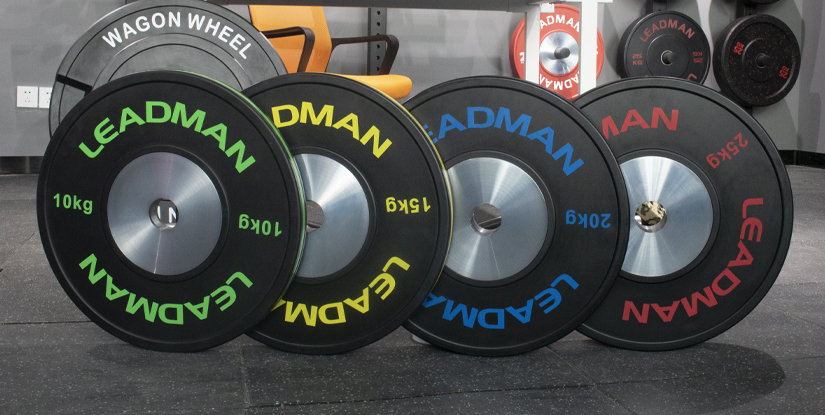
On the surface, 1 kilogram equals 2.2046 pounds. Simple enough. But in real gym applications, what matters is "balanced pairing." If you have a pair of 20kg plates, the conversion gives you 44.092 pounds. Trying to substitute two 45-pound plates gives you 90 pounds—approximately 40.8 kilograms. That is a 2-kilogram discrepancy. For a powerlifter tracking a max attempt, that margin is unacceptable. Professional kg to lbs plate conversion must therefore focus on "weight class matching," not raw multiplication.
| Kilograms (kg) | Pounds (lbs) | Practical Pairing Suggestion |
|---|---|---|
| 2.5 kg | 5.51 lbs | Use 5 lb plate (-0.5 lb error) |
| 5 kg | 11.02 lbs | Use 10 lb plate (-1 lb error) |
| 10 kg | 22.05 lbs | Use 2 x 10 lbs or 1 x 25 lbs (significant error) |
| 20 kg | 44.09 lbs | Close to 45 lb plate (+0.9 lb error) |
| 25 kg | 55.12 lbs | Use 55 lb plate (-0.12 lb error) |
Why Mixing Systems Actually Damages Equipment
Here is what many operators overlook: sleeve tolerance. The 50mm Olympic standard was designed around the metric system. Cheap pound-based plates often have oversized inner holes—exceeding 50.5mm—or inconsistent thickness. When you mix different systems on a high-precision kilogram Olympic bar, you create eccentric loading and wobble. Over time, that wobble accelerates wear on the bar's sleeves. Worse, it can cause plates to shift during heavy deadlifts. Understanding kg to lbs plate conversion is therefore not just a math exercise. It is a mechanical compatibility problem with real consequences for asset lifespan.
Two Fast Mental Shortcuts for the Gym Floor
For coaches and experienced lifters, walking around with a phone calculator is not realistic. Here are two simplified conversion methods that work within acceptable error margins:
- Rough Estimation (±2% tolerance): Simply multiply kilograms by 2.2. For example, 100kg equals 220lbs. This works for warm-up sets or accessory work but should never be used for max effort attempts or competition prep.
- Commercial Procurement Strategy: If your facility must support both systems simultaneously, the most reliable solution is buying dual-marked plates. Modern manufacturers can produce plates clearly stamped with both "20kg / 44lbs" on the same face, eliminating conversion entirely at the point of loading.
One more critical note: if you only have pound plates but must use them on a kilogram bar, always include the bar weight in your calculation—typically 20kg or 45lbs. A surprisingly common error is calculating plate weight only, forgetting the barbell, which throws off every conversion from the start.
Manufacturer Precision Standards for Mixed Use
For responsible equipment suppliers, addressing kg to lbs plate conversion requires providing a formal weight tolerance report. International standard EN 20957 states that the deviation between nominal and actual weight should not exceed ±3% for general use plates. For mixed-system environments, the recommended approach is producing "kilogram-pound dual-calibrated plates." This means the casting mold includes indentations for both measurement systems. The benefit is twofold: it eliminates user calculation errors and significantly reduces liability risk. A plate labeled 20kg should measure between 19.4kg and 20.6kg. If that same plate also shows 44lbs, the pound reading must fall within the corresponding tolerance band.
| Plate Class | Tolerance Standard | Typical Application |
|---|---|---|
| Commercial Gym Grade | ±3% (EN 20957) | General fitness, group training |
| Competition Calibrated | ±0.5% to ±1% | Powerlifting, Olympic weightlifting |
| Dual-Marked Mixed Use | Must satisfy both ±3% bands | International facilities, hotel gyms |
The Future: Unified Standards and Digital Solutions
The rise of smart gyms and digital tracking apps is slowly reducing the pressure on manual conversions. Intelligent barbell plates now come with embedded chips. They can display weight on a screen in either kilograms or pounds instantly. The user never needs to calculate anything. However, during this transition period, fitness professionals still need solid kg to lbs plate conversion fundamentals. Precision weight management remains the first step toward injury prevention and reliable linear progression. Do not let a simple unit mismatch derail months of careful programming.